Rules
By part, category or color
Match on the category, the part name, the part number (BrickLink or Rebrickable), or the color. A rule can match any or all of its conditions.
basically Sorter
An automatic LEGO® sorting machine. Bulk pieces go in the top, and each one is identified by part and color and dropped in the bin your rules choose.
The Brick Sorting Machine
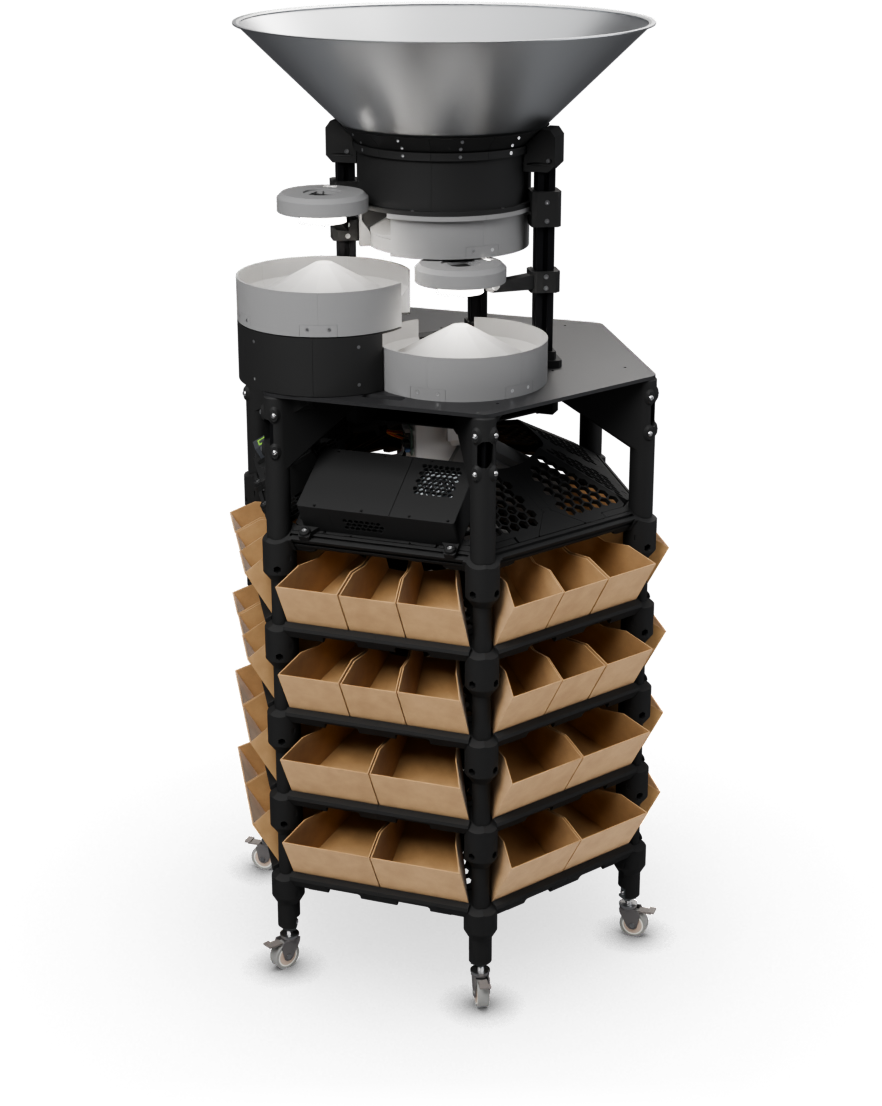
The Sorter is an automatic LEGO® sorting machine. Pour bulk pieces into the bucket at the top. It separates them, photographs each one, identifies its part and color, and drops it in the bin your rules choose.
It comes as a kit you build: a 2020 aluminum extrusion frame, printed parts, stepper motors, a custom control board and an Orange Pi 5 computer. You run it from a web browser, with live camera feeds, bin tracking and a record of every piece. The design files and code are public.
From the bucket to a bin in five steps. The feeder separates pieces with rotating channels instead of vibration, and one motor turns the chute for every layer.
01Bucket
Pour bulk LEGO® pieces into the bucket at the top of the machine.
02Feeder
Three rotating channels pull the pile apart into single pieces. Each is a circular V-channel inside a still outer wall, and pieces separate on the drops between them, with no vibration. Two cameras watch the channels, and detection and tracking run on the machine.
03Camera
A fourth channel carries each piece under a 4K camera, which photographs it. Only a cropped photo of the piece is sent to Brickognize, an online LEGO recognition service, which returns its part and color.
04Rules
Your sorting profile picks the bin for that part and color.
05Chute
The bins sit in stacked rings around a rotating chute. One motor turns the chute to the bin, and a flap on that layer drops the piece in.
Each layer is a hexagon of six bays around the chute, with one servo and one flap. Layers of small and medium bins can be mixed.
Small bins
18
On a layer of small bins, three to a bay.
Medium bins
12
On a layer of medium bins, two to a bay.
In the kit
48
Three layers: two of small bins and one of medium.
A sorting profile is a list of rules. The first rule a piece matches picks its bin.
Rules
By part, category or color
Match on the category, the part name, the part number (BrickLink or Rebrickable), or the color. A rule can match any or all of its conditions.
Fallbacks
Everything else
Pieces no rule matches can go to bins by color, by BrickLink category or by Rebrickable category, and anything left goes to a default bin.
Sets
Sort toward a set
A set profile sorts toward one set’s parts list and tracks its inventory and progress as pieces are identified.
Profiles
Shared with other owners
Profiles are shared through Hive, the community platform, so one owner’s profile can run on another’s machine.
| Cameras | Three USB cameras. Two watch the feeder channels, and a 4K camera photographs each piece. |
|---|---|
| Recognition | Brickognize, an online LEGO® recognition service, identifies the part and color. It needs an internet connection. Only a cropped photo of each piece is sent. It recognizes the most common few thousand LEGO parts. |
| On the machine | Detection and tracking run on the machine. |
| Computer | Orange Pi 5 single-board computer. Controlled from a web browser. |
| Electronics | A custom control board drives the motors, servos and lights, with one small adapter board per bin layer. The board designs are published in KiCad. |
| Motors | Four stepper motors drive the feeder channels, one larger stepper turns the chute, and one servo per bin layer works its flap. |
| Power | 24 V, 350 W internal power supply that plugs into a standard outlet. About 30 W while sorting and about 20 W idle, measured at the wall on one of our machines in August 2026. Under 70 W in a full-load stress test. |
| Size | Footprint about 76 × 84 cm, and about 1.6 m tall with four layers. From CAD, not measured. |
| Frame | 2020 aluminum extrusion and wood plates, on six casters. |
| Data | An hourly status ping you can switch off. Images are shared only if you opt in. |
The design files and code are public on GitHub, and the CAD is public in Onshape.
The hardware and the documentation are licensed under CC BY-NC-SA 4.0, and the software under MIT with the Commons Clause.
Machines you buy from us can be used for anything, including commercially. Using the design files commercially, including running a machine you built yourself as a sorting service, needs a license.
Machines built by the community report to Hive. Figures as of 14 September 2026.
Machines
11
sorting in the community fleet.
Pieces
320,000+
sorted into bins since June 2026.
Of LEGO®
320 kg
at least, processed since June 2026.
Parts
3,944
recorded, in 92 colors.
Over 1,300 people are in the Discord.
Join the DiscordKickstarter, planned for February 2027
$10 for $7,200
The voucher buys a private link, emailed the day the campaign opens, to a Sorter kit at $7,200 instead of $9,000. It is open for the first 48 hours, for 40 kits in batch 1, estimated to ship August 2027.
If you do not back the campaign, email us up to 30 days after it ends and we refund the $10. It is not a deposit and not a Sorter.